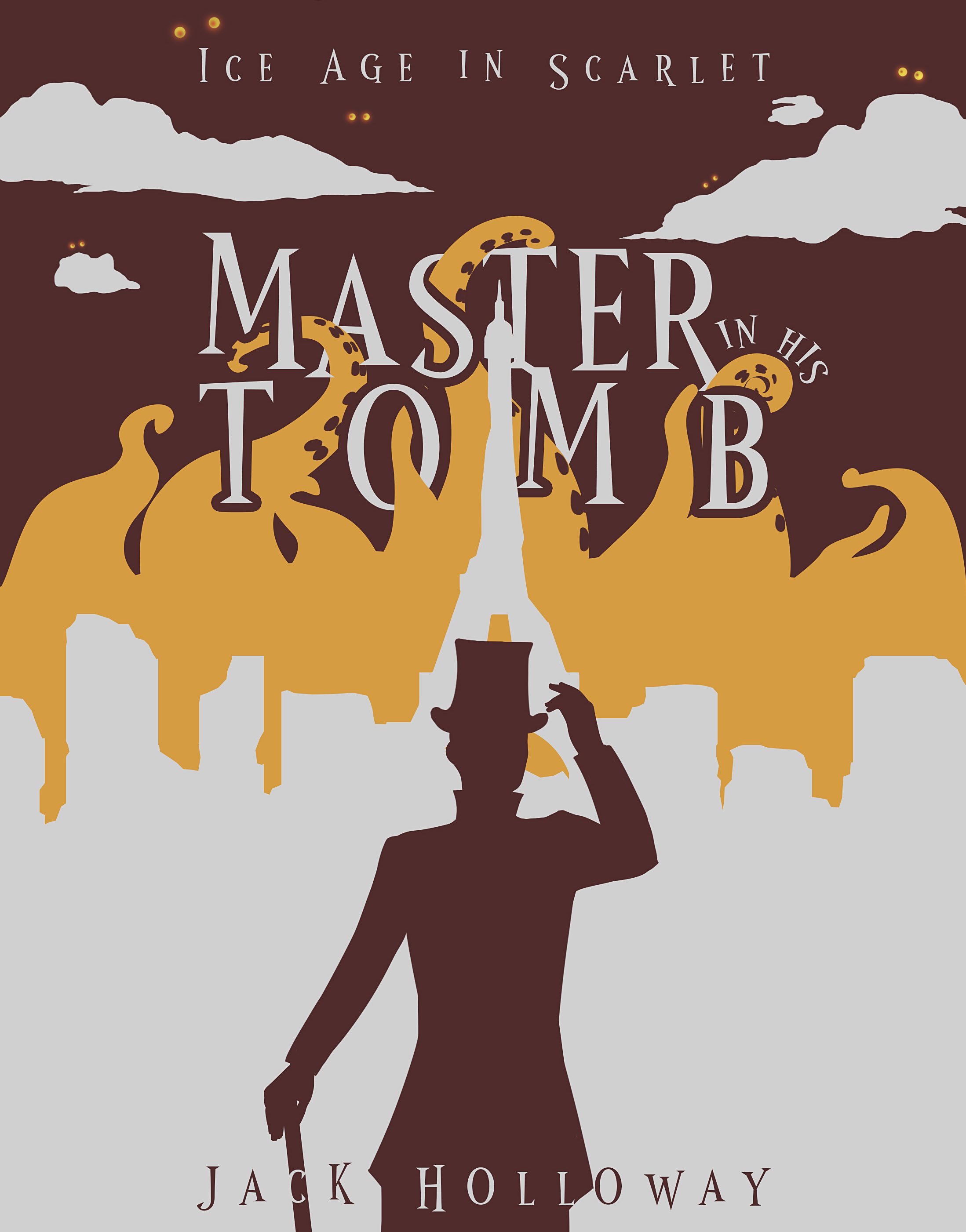
The first part of this series of blogs dealt with the best books to read first to get the background to the Ice Age in Scarlet series. Those were Master in his Tomb (pre-order up soon…) and then the countdown prequels, helpfully numbered 5 through 1 and ending at the moment the first aftershocks of the Catastrophe hit London.
Now the actual Catastrophe is something a little different. It would be fair for you to think that the Pacific Rim falling into the sea, and the sun being blotted out for a decade would be enough of a disaster to merit the term. But it is actually the actions taken by the survivors following the seismic events that cause the ongoing state of affairs which form the backdrop to the main series and its eventual conclusion.
The Universe’s fundamental elements are given a good shake and fall in new patterns that take some adapting to for the survivors.
So, where next then?
3. Watcher on the Water
A full length novel set between six months and a year after the Catastrophe following the last surviving… person… still in a Kent port and their relationship with an unwanted visitor from the collapsing Vampire State across the water.
There is also a flashback at the end showing how this, actually familiar, character from the prequels ended up in this state, and in this place. It highlights the initial work done by the Union to hunker down in the immediate aftermath of the Catastrophe and survive the wars that have erupted on the continent through a mix of covert actions by the newly empowered Agents, keeping its head down, and completing its part of the Last-Light plan which fails across the rest of the world.
The main themes in the book are integration of disparate elements into a whole, and the choice that faces most of the characters in the main series. When things are subject to tumultuous change do you try to protect the status quo (as represented by the Union), or choose to move on to adventures new (as represented by the visitor).
The climax of the book is that choice, and it links to the end of the last section the following novels which deal with a Witch returning home after giving up on pushing the Union down brighter paths, along with her apprentice, an orphan from the initial stages of the collapse of civilisation.
4. and 5. Witch in the Woods/Paths through the Dark – a duology
This was the most difficult of the series to write, bar the Tower.
God that was hell to write; I’ll get to that in due course.
Basically the issue was that the main story is simple, a chase from a point in the North of England where the Union has set up its operations base, to the Kent port in the Watcher on the Waters where the only way in and out of Union territory without permission of the Authority exists.
However the side stories took on a life of their own. The Minister in charge of the Union following the disappearance of the Government’s evacuation flights over Ireland has a complicated political and (later) physical struggle against the Agency which has ideas above its station. The Agency, as represented by Mr. Brooker from 5, has a struggle of its own between Brooker’s faction who believe in the Union, just their version of it, and the Ultras who see no point to political entities in a world of Magic but play along until they’re ready to make their move.
Then there’s the chasing forces who consist of military men and a shifting cast of supporting agents from various factions. Thespian reappears, as does the Calais crew of discards from the Agency sent to intervene on the Continent for lack of anything better to do with them which brings in all of them including the redoubtable Johnson-Pole.
Then there’s left over Fae, the Constant Companion, the characters of the previous novel seen from a distance and the Witches trying to help their Sister and the newbie get home as the Union’s Agents tear away mindlessly at the fabric of the leylines…
There’s even the Druid who sits at the end of the World Woods trying to build his dry stone wall setting a clear limit to where anyone sane would want to go.
Vampires didn’t emerge from nothing.
So it’s probably unsurprising it was complex to write and ended up spread over two full sized novels. It needed that depth to get everyone where they needed to be and wrap up all those storylines in a neat little bundle.
And as it is a duology, it needs to be read one after the other as neither book makes a great deal of sense without the other.
6. Bell Tower
Bell Tower.
How I hate you, but I’m so very pleased I wrote you.
I did have a quick crisis over which book would be the best follow up to the Witch Duology above. The rest of the main series tends to be a run in to the events of Master in his Tomb, showing how each of the characters in that book ended up where they were at the time that takes place, and the efforts of Johnson-Pole and the Calais survivors to find ways to recover what had been lost in the Catastrophe which leads Johnson-Pole on his quixotic pursuit of Albie’s resting place.
Bell Tower has to go somewhere though, and chronologically… well chronologically it’s all over the place so ‘here’ is where it goes. It takes places after the Witch duology and extends in various permutations over the lifetime of the Union all the way through the heat death of the Universe.
I may be slightly overstating but not by much.
The book is based around a research base in the Far East where the Union has been sending rather too many of its best scientists in the expectation that a Tower discovered there which can withstand the Clouds and their denizens will provide a breakthrough into, well, something.
That’s the problem. The Tower is so amazing in its basic concept that it almost feels it’s there like a honeypot to attract exactly the sorts of people the Union would otherwise need to understand the rules of the Universe post Catastrophe, yet whenever any progress is made it’s a dead end. The Tower is a marvel but one that it is fundamentally impossible for humans to do anything with due to its nature, and theirs.
Then there’s the temporal effects. Characters can be running forward, backward, jumping from point to point. The single element of stability for the reader is the POV character who moves from point A (arrival) to point B (conclusion) as the people around him seem to pop in and out of existence with some minimal continuity reflected in the POV character’s understandable conclusion.
Links to the other series books are there, there’s a soldier from the Witch duology on his last tour. The POV character is one you met in 4, giving a rather ineffective presentation to the arms dealing organisation that employs the main character in that prequel novella. There’s a reference to where the population of the Seis in Belle in Twilight end up when they disappear into the world woods.
Key themes are the inability of the human mind, no matter how clever or educated, to avoid seeing patterns in chaos, and the impact that can have on meaningful investigation. No matter how many people you send to stare at the clouds, they remain fundamentally impossible to understand.
The trick is to never look in the first place.
 Ice Age in Scarlet